 SF-ES-01
Back to Home
Safir Hotel · Fergana Valley
Sustainability
Genuine hospitality with a light footprint — caring for the nature and the community of the Fergana Valley.
Explore our report“Our main goal is to offer guests high-quality service with minimal impact on the environment, and to create a model of eco-responsible hospitality in the Fergana Valley.”
Overview
Hospitality that cares
Safir Hotel's management is committed to protecting the environment, using natural resources wisely and following the principles of sustainable tourism in everything we do.
We don't treat sustainability as a slogan. We measure, set targets, act and report openly — from the lights in our corridors and the towels in your bathroom to every kilogram of food left over at breakfast.
Guided by recognised standards
O'zMSt 480:2025
National standard «Eco-labelling»
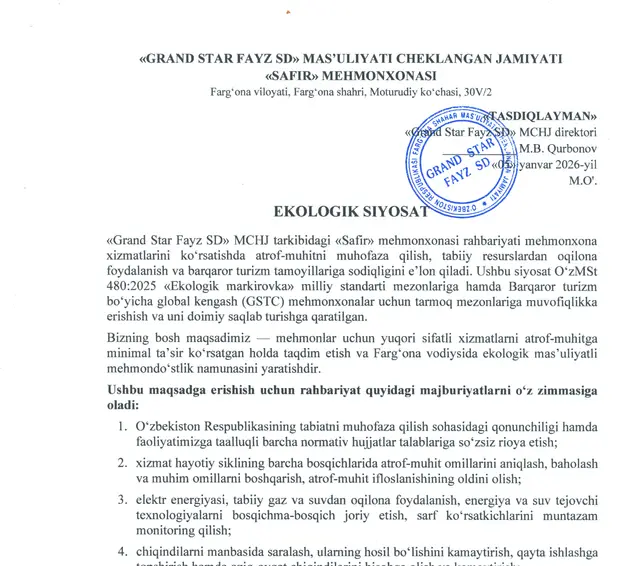
Our Environmental Policy is designed to meet and continuously maintain the criteria of Uzbekistan's national eco-labelling standard.
GSTC
Global Sustainable Tourism Council
We align our practices with the GSTC Industry Criteria for Hotels — the global benchmark for sustainable hospitality.
Impact at a glance
3,718kg
of food waste weighed, recorded and analysed by source in 2025
79.1%
of 2025 food waste handed over to be processed into animal feed
−63%
less expired-product waste in the first half of 2026 compared with 2025
238g
of food waste per guest-night in June 2026 — below our 240 g annual target
What We Do
Eight directions that turn our Environmental Policy into everyday practice.
Our approach is built on the O'zMSt 480:2025 «Eco-labelling» national standard and the GSTC Industry Criteria for Hotels.
- Full compliance with Uzbekistan's environmental legislation and regulations
- Measurable environmental goals and an approved annual action plan
- A person responsible for food waste management appointed by order
- Results reviewed quarterly and the policy reviewed annually by management
We use electricity and natural gas wisely and monitor consumption regularly.
- Motion sensors in all corridors and common areas, including public restrooms — lights switch on only when someone is present
- Energy-saving lighting in common areas and guest rooms
- Step-by-step introduction of energy-efficient technologies
- Regular monitoring of electricity, gas and water consumption
Every towel and sheet that doesn't need washing saves water, detergent and energy, and keeps wastewater cleaner.
- «Help us save the planet!» towel reuse programme with signs in three languages in every bathroom
- Optional daily linen change — guests simply leave a card on the bed
- Water-saving sanitary fixtures in rooms and common areas
We reduce waste at the source, sort it and send what we can for recycling.
- Waste sorting points in common areas
- Separate collection of organic waste in the kitchen
- 79.1% of 2025 food waste handed over to a specialised farm for animal feed
- Goal for 2026: raise this share to 90%
Since June 2025, every kilogram of food waste is weighed on electronic scales and recorded by category.
- Smaller dishes at the breakfast buffet, refilled according to guest flow
- Daily food planning based on the occupancy forecast
- Two portion sizes for selected dishes on the menu
- Strict FIFO and weekly shelf-life checks in storage
We give priority to products from local producers.
- Shorter supply routes mean a lower transport-related environmental burden
- Supporting farmers and producers of the Fergana Valley
- Near-expiry products are used first in staff meals instead of being thrown away
We are gradually switching to cleaning and laundry products with a lower environmental impact.
- Transition to eco-labelled washing and cleaning products
- Fewer unnecessary washes thanks to the towel and linen programmes
- Lower detergent use and less wastewater pollution
Sustainability works only when the whole team — and our guests — take part.
- Regular environmental training for staff; hands-on kitchen trainings held on 27 April and 11 May 2026
- Trilingual information cards on food waste in the breakfast area
- Open and honest reporting of our results to staff, guests and partners
Environmental Policy · SF-ES-01
Our Environmental Policy
Approved by the director of «Grand Star Fayz SD» LLC on 5 January 2026, the policy sets out the commitments the hotel's management takes on to protect the environment.
High-quality service, minimal environmental impact — and a model of eco-responsible hospitality for the Fergana Valley.
Nine commitments of our management
- 01
Strictly comply with Uzbekistan's environmental protection legislation and all regulations that apply to our activities.
- 02
Identify and assess environmental aspects at every stage of the service life cycle, manage the significant ones and prevent pollution.
- 03
Use electricity, natural gas and water wisely, introduce energy- and water-saving technologies step by step and monitor consumption regularly.
- 04
Sort waste at the source, reduce the amount generated, send it for recycling, and record and reduce food waste.
- 05
Gradually switch to eco-labelled washing and cleaning products with a low environmental impact.
- 06
Give priority to local producers in purchasing, reducing the environmental burden of transport.
- 07
Continuously raise staff environmental awareness and engage guests in resource-saving initiatives.
- 08
Set measurable environmental goals, approve an annual action plan, monitor its implementation and keep improving performance.
- 09
Keep staff, guests and stakeholders objectively informed about our environmental performance.
The «Eco Policy» programme in action
The policy is part of our daily routine through these practical measures.
Towel reuse
«Help us save the planet!» signs in Uzbek, Russian and English in every bathroom: a towel on the floor means «please replace», a towel on the hook means «I'll use it again».
Linen on request
Bed linen isn't changed daily by default. A trilingual card in every room — leave it on the bed and we'll change the sheets.
Motion sensors
In all corridors and common areas, including public restrooms, lights turn on only when movement is detected and switch off automatically afterwards.
Efficient infrastructure
Energy-saving lighting, waste sorting points and water-saving sanitary fixtures in common areas and guest rooms.
Guest awareness
We explain to guests why it matters: less water use, less detergent and less wastewater pollution.
The policy is communicated to all employees, displayed on the hotel's information boards and reviewed for relevance every year during management review. The director holds overall responsibility for its implementation.
Food waste report · SF-OT-20
Food Waste: 2025 Results
We measured how much food waste our restaurant generated in 2025, where it came from and what can be done about it. Calculations are based on 13,900 guest-nights; the restaurant mainly serves breakfast and daily meals for hotel guests.
13,900
guest-nights in 2025
3,718kg
of food waste over the year
267g
per guest-night on average
−13.8%
per guest-night from January (290 g) to October (250 g)
Food waste per guest-night
grams, by month · 2025
From June 2025, measurements were taken in full under instruction SF-RI-19 — on electronic scales, separately for each category. Data for the first half of the year were recalculated from daily kitchen logs and records of organic waste handed over.
Where food waste comes from
We divide food waste into four categories. Knowing the source tells us exactly where to act — and which losses can be avoided completely.
Buffet (breakfast) leftovers
42.2%1,570 kg
The main source. A large part is avoidable: serving dishes in smaller containers and refilling them according to guest flow.
Preparation waste
34.4%1,280 kg
Partly unavoidable (peels, bones). Can be reduced through correct cutting and full use of each product.
Plate leftovers
18.3%682 kg
Reduced by adjusting portion sizes and giving guests a choice.
Storage waste (expired products)
5.0%186 kg
Should be eliminated completely. FIFO and shelf-life control are being strengthened.
Key findings
13.8% less per guest
Waste per guest-night fell from 290 g in January to 250 g in October — thanks to the new measurement instruction (June), smaller buffet dishes and step-by-step breakfast refilling.
Busier months, better efficiency
The highest volumes were in May (369 kg) and April (359 kg), yet per-guest values were lowest (260 g). In winter, fewer guests but the need for a minimum buffet selection pushes the ratio up.
186 kg that could be avoided
Expired products (T4) are fully preventable losses — that's why they became the top priority for 2026.
2,941 kg became animal feed
79.1% of all food waste was handed over to a specialised farm for processing into animal feed; the rest left with mixed household waste.
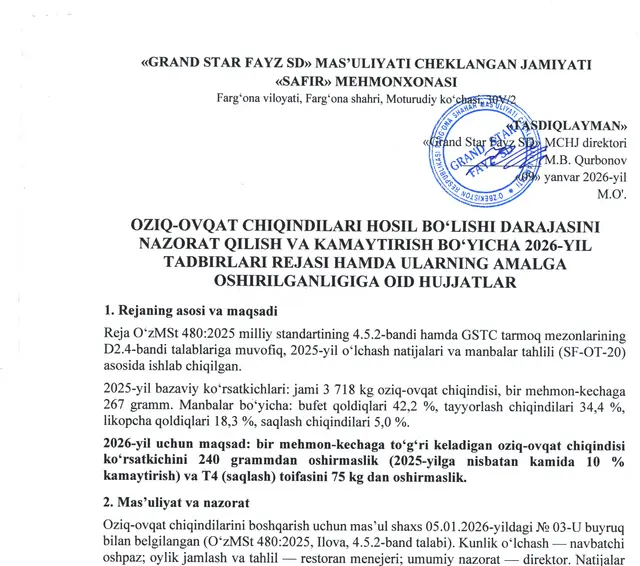
Action plan · SF-RJ-21
2026 Reduction Plan
Built on the 2025 measurements and source analysis, in line with clause 4.5.2 of O'zMSt 480:2025 and GSTC criterion D2.4. Implementation status is updated as of 15 August 2026.
Our targets for 2026
≤ 240g
of food waste per guest-night by the end of 2026 — at least 10% less than in 2025
≤ 75kg
maximum storage (expired-product) waste for the whole year
90%
of organic waste to be handed over for animal feed
Implementation status
Updated 15 August 2026
7/10measures fully completed
- Completed — 7
- In progress — 2
- Planned — 1
№MeasureExpected resultDeadlineResponsibleStatus
- 01
Use smaller dishes at the breakfast buffet and refill hot and cold dishes step by step according to guest flow
Dishes were replaced in February 2026; the refilling procedure was added to the breakfast technological chart.
- Expected result
- T2 −15%
- Deadline
- 01.03.2026
- Responsible
- Restaurant manager
- Status
- Completed
- 02
Strengthen FIFO and shelf-life control in storage, with weekly inspections
A weekly inspection log is kept; products are labelled with their date of receipt.
- Expected result
- T4 −60%
- Deadline
- 01.03.2026
- Responsible
- Restaurant manager
- Status
- Completed
- 03
Plan daily food quantities based on the occupancy forecast
Every evening, occupancy data for the next day is passed to the kitchen.
- Expected result
- Total volume −8%
- Deadline
- 01.05.2026
- Responsible
- Restaurant manager
- Status
- Completed
- 04
Review portion sizes and let guests choose their portion
Two portion sizes were introduced for selected dishes on the menu.
- Expected result
- T3 −10%
- Deadline
- 01.06.2026
- Responsible
- Restaurant manager
- Status
- Completed
- 05
Hands-on training for kitchen staff on full use of products and FIFO
Trainings held on 27 April and 11 May 2026.
- Expected result
- T1 −5%
- Deadline
- 30.04.2026
- Responsible
- Restaurant manager
- Status
- Completed
- 06
Improve separation of organic waste and increase the share handed over for animal feed
The share reached 85% in the first half of the year.
- Expected result
- Share up to 90%
- Deadline
- Throughout the year
- Responsible
- Chief engineer
- Status
- In progress
- 07
Place trilingual information cards on reducing food waste in the breakfast area
Cards installed in the buffet area.
- Expected result
- Guest engagement
- Deadline
- 01.04.2026
- Responsible
- Restaurant manager
- Status
- Completed
- 08
Compile and analyse daily measurements monthly and present results to management
Monthly summaries (form F-19/2) are maintained.
- Expected result
- Continuous monitoring
- Deadline
- Every month
- Responsible
- Restaurant manager
- Status
- In progress
- 09
Use near-expiry products first in staff meals
- Expected result
- Further T4 reduction
- Deadline
- 01.07.2026
- Responsible
- Restaurant manager
- Status
- Completed
- 10
Analyse the year's results and set targets for 2027
- Expected result
- Continuous improvement
- Deadline
- 31.12.2026
- Responsible
- Director
- Status
- Planned
First half of 2026
Food waste per guest-night, g — January–June 2026 vs 2025
- 2025
- 2026
- Target 240 g
248g
per guest-night in H1 2026 — 7.8% less than 269 g in the same period of 2025
34kg
of expired-product waste in H1 — 63% less than 93 kg a year earlier. Target achieved
85%
of organic waste handed over for animal feed (annual target 90%)
Responsibility & control
A person responsible for food waste management was appointed by order No. 03-U of 5 January 2026. Daily measurement — duty cook; monthly summary and analysis — restaurant manager; overall control — director. Results are reviewed every quarter at the management review meeting.
Records we keep
- Daily measurement logs (F-19/1)
- Monthly summaries and analysis (F-19/2)
- Breakfast technological chart and buffet refilling procedure
- Weekly storage inspection log
- Daily food planning records based on occupancy
- Training attendance sheets (F-13/2)
- Organic waste handover certificates (F-17/1) and log (F-18/1)
- Trilingual guest information cards
Next steps
7 of 10 measures are fully completed, 2 run continuously and 1 is scheduled for year-end. In June, waste per guest-night fell to 238 g — below the annual target. At the end of the year we will summarise the results, update the source analysis and approve new targets and an action plan for 2027.
Documents
Original documents
Transparency matters to us. View or download the signed and sealed originals of our sustainability documents.
SF-ES-01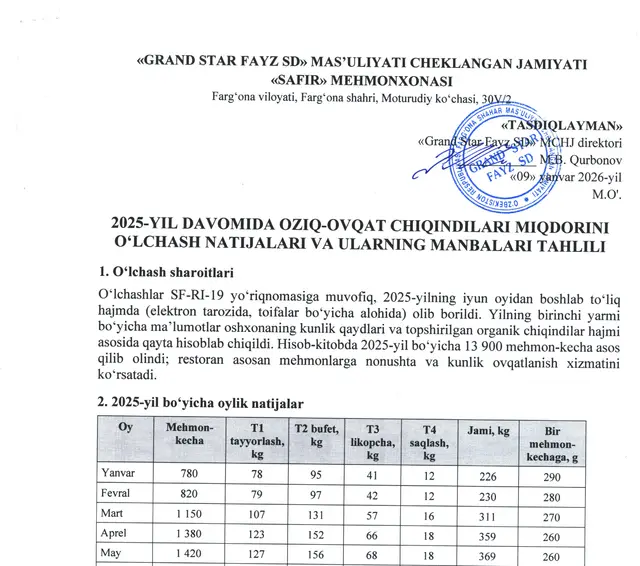
Documents are published in their original language (Uzbek). Key information from them is presented on this page in Uzbek, Russian and English.

Stay with us
Every guest can make a difference
Small choices during your stay add up. Thank you for helping us care for the Fergana Valley.
Hang your towel on the hook if you'd like to use it again
Leave the linen card on the bed only when you want your sheets changed
At breakfast, take a little at a time — the buffet is refilled throughout the morning
Use the waste sorting points and help us save water and energy